
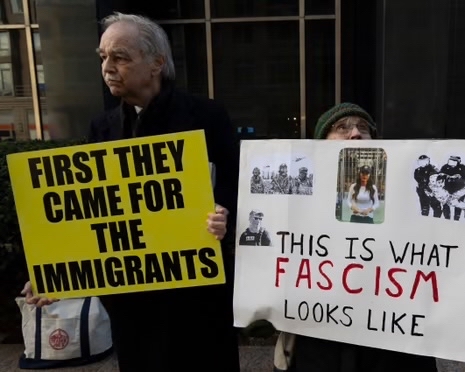
The rise of Facism and immigration as its fuel
OK. In order to go forward, sometimes we have to take a step back.
Let’s go back 10 years. February 2016. Imagine I’m talking to you then, with a list of predictions about the next decade.
First: Farage wins the Brexit debate. The UK leaves the EU and inflicts great harm on itself.
Second: The polls are wrong. Hillary Clinton doesn’t win the White House. The loon Trump does.
You think that’s mad? I’ve more.
- Trump loses to Biden in 2020, then coordinates an insurrection to steal the election. People die storming Capitol Hill.
- Putin invades Ukraine.
- Israel conducts a genocide in Gaza. Biden arms it.
- Trump, unprosecuted, returns to the White House, dismantles US institutions, and proposes turning Gaza into an American-controlled Riviera.
- We get an American Pope.
- And by the time we reach February 2026 polls show Nigel Farage is favourite to be the next UK Prime Minister.
None of us would have believed it, would we? But here we are.
Why does this matter? Because there are other things that could happen—less seismic, less extraordinary than what we’ve already lived through—that would tip the world into full-blown fascism.
Imagine Farage and Reform take office in Britain. Imagine AfD do the same in Germany. Imagine National Rally finally pull it off in France too. We already have Putin’s imperialist oligarchy, Orbán as his willing poodle, and Trump’s America continuing under Vance or some other zealot.
What is this, if not a fascist hegemony?
You might tell me those events are unlikely. I would counter with, ‘I certainly hope so but they are closer to reality than anything we could have imagined 10 years ago’. And in every country I’ve mentioned, the fuel driving nationalist and ultimately fascist hatred is the same: immigration.
Let’s be clear about something. This didn’t happen by accident. When Farage is on a podcast with a billion-dollar audience, when you see AfD talking points replicated in Dublin pubs, when you see the same “great replacement” garbage surfacing in Drogheda as in Dresden—that’s not accidental. That’s an international playbook with international funding and organising.
The usual suspects are involved. Musk’s and Zuckerberg’s algorithms boosting far-right accounts. Russian disinformation farms weaponising European resentment. American dark money finding its way into “grassroots” European campaigns like we first seen here on Repeal and Marriage Equality but has now ‘migrated’ to immigration.
But here’s the thing: that playbook only works if there’s timber to ignite. And we on the left spent too much of our time soaking that timber in petrol.
I need to say this carefully, because I’ve spent my life in the labour movement fighting for equality and I don’t want to be misread. But here it is: while we were arguing about ‘culture issues’, they were taking our arguments about poverty and turning them into arguments about borders. While we were constructing ever more sophisticated frameworks of identity, working-class communities were watching as their public services creaked, their housing needs were monetised for billionaires, their children forced to emigrate—and were being told that the correct response to all this was to ‘check their privilege’.
We cannot tell people that their material reality doesn’t matter and expect them to stay in the room.
The far-right offered them an answer. It was a lie—immigration didn’t cause the housing crisis, didn’t close the factories, didn’t gut the health service. But it was an answer. And the left, in too many places, had stopped offering any answer at all. Just a vocabulary test. We went from winning on water to losing our people. And cutting each others throats in the process.
This is the convergence. International far-right networking meets domestic left-wing failure. The algorithms kick in and amplify the lies while the absence of a credible alternative makes the lies believable to the gullible. The hate filled lies are rammed into their brains by their phones as surely as if Musk injected them with a syringe.
In Ireland, we’re not as far down this road as others. But we’re definitely on it. ‘Neutrality’ won’t pass muster in this debate. Why? If the only people talking (or at least being heard) about working-class suffering are the far-right, working-class people will eventually listen to the far-right. Not because they’re racist—though some sure are—but because they’re desperate, and desperate people reach for whoever acknowledges their pain.
None of this means there shouldn’t be a debate about migration. Of course there should. A rules-based system of sustainable migration is necessary—economically, socially and humanely. It’s as natural for people to want to come to Ireland as it has been for generations of our own to leave. That’s not the argument.
The argument is about what happens when the debate is poisoned. When migration is used not to build a functioning society but as the fascist fuel to tear it apart. When the far-right doesn’t want solutions—it wants scapegoats. And when the mainstream left, having seemed to abandon class for culture, has no answer except to change the subject.
The last decade of complacency and mismanagement—by governments, by institutions, and yes by parts of the left itself—has raised the stakes to crisis levels. We are no longer debating policy in normal times. We are a few electoral twists away from a full blown fascist hegemony, and the question is whether our freedoms, our parliamentary democracies, our basic capacity to treat each other as human beings, survives. Because it won’t survive fascism. Such is the nature of, and reason for the very existence of, fascism.
So here’s a question we need to start facing up to — if the far-right takes power across much of Europe who will stand up? And how? We now see how authoritarianism in both the United States and Russia is licking its greedy lips.
That’s for next time. For now, understand this: the immigration debate was never just about immigration. It was always about whether we can stop fuelling the hate that will cost us all our freedom. Can we?